

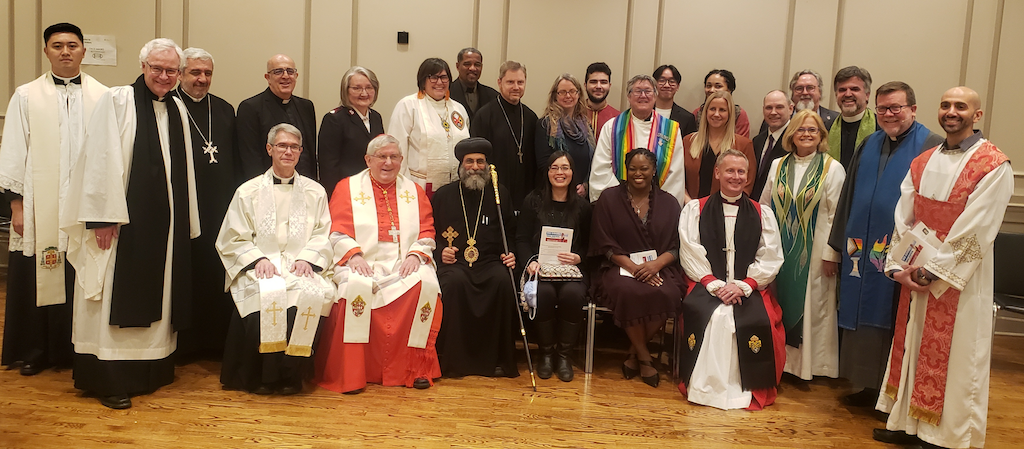
Week of Prayer for Christian Unity (WPCU) service annually held late January & organized by the international WPCU writing team. This year, held at St. Andrew’s (King Street), Toronto organized by the GTA Christian Council of Churches, service and resources prepared by the Minnesota Council of Churches.
Facilitates and maintains relationships with ecumenical and interfaith councils, committees and consultations, while developing strategies concerning peaceful and respectful ecumenical and interfaith education and work.
The Presbyterian Church in Canada believes in the importance of our ecumenical and interfaith work and partnerships. This work happens in many different contexts, from local gatherings to large international organizations. Many Canadian Presbyterians dedicate significant time and energy to the work of ecumenism and interfaith endeavours in local, national and international settings. The Ecumenical and Interfaith Relations Committee (EIRC), a standing committee of the General Assembly, supports and fosters such ongoing involvement. The following pages offer an overview of the work and partnerships of this committee.



News and Events
Gyana PC Marks Milestone in Healing and Reconcilliantion
Over the past couple of years, The Presbyterian Church in Canada has supported mediation work within the Guyana Presbyterian Church (GPC) a long time partner of The Presbyterian Church in Canada. That mediation work was led by a team from the World Communion of Reformed Churches (WCRC) and was supported financially through The Presbyterian Church in Canada.
We are very pleased that the work of mediation has resulted in the election of a new Synod Executive Committee and a landmark Synod meeting which was held on April 17-18, 2026, under the theme, “Gathered in Thanksgiving, Restored in Love.” We rejoice with our friends and continue to pray for the Guyana Presbyterian Church and for its future in serving the people of God and the witness of the gospel.
Canadian Interfaith Conversation issues statement: Standing Together Against Hate Based on Religious Identity (June 2024)
 The Canadian Council of Churches Governing Board Meeting – Highlights and Decisions (November 2022)The Canadian Council of Churches Governing Board Meeting – Highlights and Decisions – French (November 2022)
World Interfaith Harmony Week
In 2010, the United Nations unanimously adopted a resolution that the first week in February be observed as World Interfaith Harmony Week.
Celebrating the Light in Different Faith Traditions
In this article, the Rev. Kenn Stright of the Ecumenical and Interfaith Relations Committee writes on the importance of light in many religions throughout the world and explores how this important symbol of the divine is celebrated across different faith traditions.
Healing Poverty
The Commission on Justice and Peace of the Canadian Council of Churches has released a reflection, Healing Poverty/Guérir la Pauvreté. This document is a resource for all levels of the church and includes reflections on poverty, questions for conversation and suggested actions.
Mapping Diversity
The Christian Interfaith Reference Group of the Canadian Council of Churches is collaborating with the National Muslim Christian Liaison Committee to facilitate ways for members of our faith communities to know each other, to foster respect and to create opportunities for dialogue and joint action locally and nationally. Together, we are working on a project to map the diversity of Muslim-Christian communities in Canada.
A Worship Service to Commemorate the 500th Anniversary of the Reformation
The year 2017 marks a significant moment in our Reformed Tradition. A worship service has been prepared by ecumenical representatives from both The Presbyterian Church in Canada and the Christian Reformed Church of North America. The theme of the worship service is the “Five Solas,” the Reformation’s main emphases of Grace Alone, Scripture Alone, Christ Alone, Faith Alone and Glory to God Alone, that are clearly present in the writings of the Reformers. Download the 500 Years of Reformation worship service including children’s messages:
500 Years of Reformation Worship ServiceChildren's Reformation Sunday Story AChilden's Reformation Sunday Story B World Council of Churches
 World Council of Churches
11th Assembly
The 11th Assembly of the World Council of Churches took place in Karlsruhe, Germany, in 2022. The Rev. Amanda Currie and Ms Lori Ransom were our church’s delegates to the Assembly.
10th Assembly
The World Council of Churches (WCC), at its 10th Assembly in Busan, South Korea, in 2014, under the theme of “God of life, lead us to justice and peace,” approved two major documents: Together Towards Life: Mission and Evangelism in Changing Landscapes and The Church Towards a Common Vision . Both of these documents are being studied throughout our denomination.
 World Communion of Reformed Churches

The World Communion of Reformed Churches is comprised of 100 million Christians from over 230 Congregational, Presbyterian, Reformed, United, Uniting and Waldensian churches in more than 105 countries.
The WCRC General Council was held in Leipzig, Germany, from June 29–July 7, 2017. More information about the General Council can be found on the WCRC website .
The Work and Witness of the World Communion of Reformed Churches Canadian Council of Churches
In 1944, The Presbyterian Church in Canada, with nine other churches that believed the faithful way to witness to Jesus Christ in Canada was to do so in relationship with one another, formed the Canadian Council of Churches (CCC). Today, the CCC is made up of 25 denominations representing 85% of Christians in Canada. In November 2014, the 70th anniversary was marked with a four-day Assembly in Mississauga. The celebration included open meetings of its commissions and working groups, panels on the future of ecumenism and our shared relationships with First Nations people, and a public service of worship at which theologian and activist Mary Jo Leddy preached.
Documents
Our Understanding of Ecumenism
One author wrote:
The word “ecumenical” is derived from the Greek term, “oikoumene,” which many be translated as “the whole inhabited world.” It is in seeing this world as God’s that we see ourselves as one. It is in seeing all the world’s people as made in God’s image that we are called to protect the welfare of every one.
The Difference Between “Ecumenical” and “Interfaith”
We live in a pluralistic society. From our schools, to our workplaces, to our homes, we interact with people of different faiths—and of no faith at all—on a daily basis. But do these relationships fall under the category of “ecumenical”?
Although these terms are sometimes used synonymously, we tend to use the term “ecumenical” to refer to our relationships and our partnerships with other Christian individuals and groups; and we use the term “interfaith” to denote those interactions and relationships with individuals and groups which would not describe themselves as “Christian.”
It is likely that an increasing amount of our focus, in the future, will be on “interfaith” issues as well as on “ecumenical” issues.
United Nations World Interfaith Harmony Week Launch Event in Calgary, Alberta
World Interfaith Harmony Week is an annual event observed during the first week of February. The Rev. Mark Tremblay from Knox (Calgary) Presbyterian Church was in attendance of the Calgary launch event in February 2017, which saw many guests from different faith groups, as well as Calgary Mayor, Naheed Nenshi, speak uplifting words of inclusion.
The United Nations General Assembly points out that mutual understanding and dialogue among different faiths and religions constitute important dimensions of a culture of peace. To enhance mutual understanding, harmony and cooperation among people, the General Assembly encourages all States during this week to spread the message of interfaith harmony and goodwill in the world’s churches, mosques, synagogues, temples and other places of worship, on a voluntary basis and according to their own religious traditions or convictions.